News

COMPUTER SCIENCE - Armaan Hajarizadeh, a third-year computer science major in the College of Arts and Sciences and a member of the Clark Honors College, has been named a Goldwater Scholar. The prestigious national award recognizes undergraduates conducting research in the natural sciences, engineering, and mathematics. After earning his bachelor’s degree, he plans to attend graduate school and eventually pursue a career in academia.
HUMAN PHYSIOLOGY - For Graduate-Professional Student Appreciation Week in 2026, CAS gradate students share their experiences of what makes their experience special at CAS. CAS is home to 1,295 graduate students: 307 master’s and 959 PhD. With April 6-10 Graduate-Professional Student Appreciation Week, CAS reached out to some of its graduate students to hear how about their experiences at the college.
HUMAN PHYSIOLOGY - John Halliwill has been named a 2025 fellow by the American Association for the Advancement of Science (AAAS). A professor in the Department of Human Physiology, Halliwill was recognized for advancing the understanding of exercise-induced cardiovascular adaptation and discovering histamine's role as a signaling molecule in adaptation to physical activity.
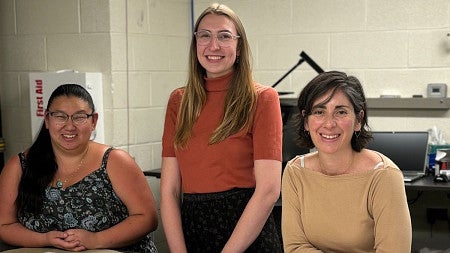
CHEMISTRY, BIOCHEMISTRY — A hands-on experience is essential to study chemistry, and labs are how students apply what they’re learning in lecture. But many students experience anxiety before entering labs so Associate Professor Cathy Wong set out to make labs more accessible and more fun.
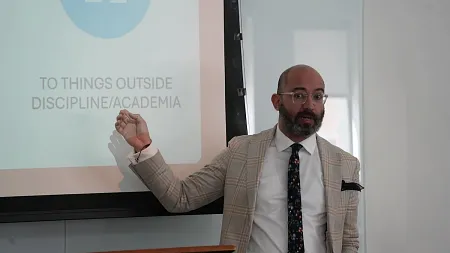
MATHEMATICS - George Lusztig is a professor at the Massachusetts Institute of Technology in Boston. He is visiting the College of Arts and Sciences’ Department of Mathematics from April 1 to 3 and will deliver special colloquium titled “Fourier transform as a triangular matrix" 4 pm Friday, April 3 at Tykeson 140, followed by a reception.
PHYSICS - Scientists led by a physicist at the College of Arts and Sciences have taken a major step in solving an enduring mystery that we encounter every time we look through a window or stare at a phone screen. The discovery could open the door to new kinds of glass materials with desirable properties.
HUMAN PHYSIOLOGY — As humans plan to return to the moon for the first time in more than 50 years, John Halliwill, a human physiology professor, spoke with CAS Connection about the wonders of space flight and what the human body endures and adapts to in the weightless realm of space — as well as when returning to Earth.
COMPUTER SCIENCE - Over the past few terms, computer science professors Hank Childs and Aye Thuzar have been working on reworking the entry level computer science class, “Fluency with Information Technology,” to incorporate AI-assisted programming. The idea is that allowing AI to take care of smaller details — like accurate syntax — allows students to cover more ground in a single introductory class.
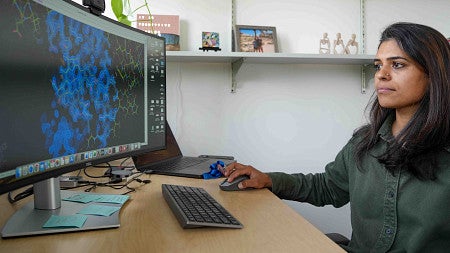
PHYSICS -At the University of Oregon’s Institute for Fundamental Science, a growing number of faculty have earned prestigious honors from the National Science Foundation and the U.S. Department of Energy, which signal both individual excellence and the institute’s positive research trajectory. The most recent winner is CAS physicist Tien-Tien Yu, who received an NSF CAREER Award followed by the Presidential Early Career Award for Scientists and Engineers.
PHYSICS - A supermassive black hole with a case of cosmic indigestion has been burping out the remains of a shredded star for four years — and it’s still going strong, new research led by University of Oregon College of Arts and Sciences astrophysicist Yvette Cendes. Cendes and her team published findings about this one-of-kind black hole in the Feb. 5 issue of Astrophysical Journal Astrophysicists.
PHYSICS - Fascinated by the unexplored corners of the universe since childhood, physicist Tien-Tien Yu has made dark matter the pillar of her research career. In her quest to understand, she’s co-founded a major experiment in collaboration with physicists at other institutions, all of whom are trying try to bring light to the dark.
PHYSICS, CHEMISTRY, BIOCHEMISTRY, BIOLOGY — A new cutting-edge major in the University of Oregon College of Arts and Sciences prepares students to drive technological change through high-demand careers in fields such as semiconductor manufacturing, energy and sustainable materials development.
BIOLOGY - Marine biologist Alan Shanks has a simple trap that allows him to predict the amount of Dungeness crab will be available for fisherfolk. For the past 25 years, Shanks has compared the yields of the winter commercial catch to the baby crabs his water-jug trap collects each summer. He’s found that the number of baby crabs that arrive on the coast can be used to estimate the size of the state’s commercial harvest of adult Dungeness crab years in the future, with a 12 percent margin of error.
CHEMISTRY AND BIOCHEMISTRY - It's August, and the fall term is around the corner, but associate professor Carl Brozek is heading to Japan through the Fulbright U.S. Scholar Program. None of them, including Brozek or the lab in Japan he'll be working in, know that he’ll be there when his research colleagues at Kyoto University get some epic news about their work on structures known as metal-organic frameworks, or MOFs.
PHYSICS - An assistant professor of physics at the University of Oregon College of Arts and Sciences, Nguyen has been named the 2025 recipient of the American Physical Society’s (APS) Maria Goeppert Mayer Award. Named after a German American theoretical physicist who was co-awarded the 1963 Nobel Prize in Physics, this award honors exceptional achievement by a woman physicist in the early years of her career.