
For many students, chemistry labs don’t start with curiosity. They start with nerves and anxiety. Before experiments in the lab begin, students have to learn to navigate unfamiliar instruments, detailed procedures and the quiet pressure of getting it all right on the first try.
Cathy Wong wants to make labs more accessible and help students feel prepared and confident conducting experiments. An associate professor in the College of Arts and Sciences (CAS) Department of Chemistry and Biochemistry, Wong set aside her usual research to explore how to make the scientific process more accessible for undergraduate students.
Along with her co-authors, Wong developed an interactive pre-lab simulation, a small shift in preparation that made a meaningful difference for students. Those who participated in the experiment walked into the lab more confident, comfortable and ready to learn.
Wong published her study in the Journal of Chemical Education, “Prelab Simulation of Microscope Building Activity in Upper Division Laboratory Improves Student Confidence.” The study’s co-authors were Zachary Walbrun, PhD,’25 (chemistry and biochemistry), and current CAS physical chemistry doctoral student Laila Nawab.
Before the lab work even begins
A hands-on experience is essential to study chemistry, and labs are how students apply what they’re learning in lecture. But Wong said she began to notice over time that students feel anxious before entering labs.
Because labs require significant time, effort and resources from both students and the university, Wong said she wanted to find ways to have students be more prepared and confident for the crucial part of a chemistry course.
“If we’re going to put all these resources into lab courses, we want students to really get something out of them,” she said.
Wong decided to study the pre-lab process and how students can feel better about entering a lab to conduct experiments. The pre-lab assignment is what a student completes before starting an experiment in the lab.
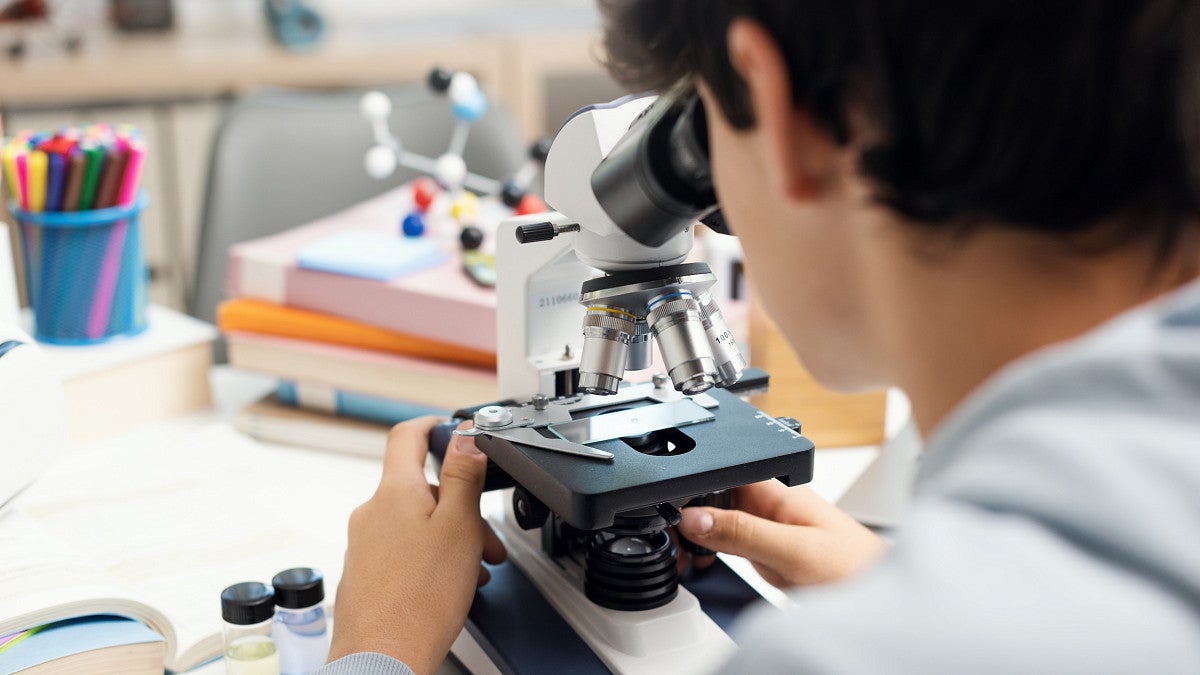
In Wong's course, her students build microscopes, commonly used tools in the lab. By building them, students develop their understanding of how they work. Before the lab began, she split the students into two groups: One group only received a worksheet to prepare for the experiment. The other used a computer simulation. To measure the impact, Wong’s team surveyed students before and after the lab, tracking their expectations, confidence and overall experience.
Both groups completed the lab with similar finish times, but the group who used the simulation reported that they felt confident and less nervous than if they had just used a worksheet to prepare.
“If you’re very anxious, it’s hard to enjoy learning, which can make it hard to learn at all,” Wong said.
When students feel prepared, they’re more likely to engage; to ask questions, to think through what’s happening, and to see the lab as an opportunity rather than an obstacle.
As online tools become more common in education, Wong is careful to draw a line: simulations are not a substitute for real lab work.
“Simulations are an excellent support tool for student learning,” she said.
A practice round, not a replacement
For Wong, the bigger goal with this research goes beyond improving a single course. This research is a way to connect students with science, whether or not the student is majoring in a STEM field.
Too often, students treat lab classes as something to endure, a difficult requirement standing between them and their degree, Wong said. Labs are where students begin to see science at work, and an experience that also teaches how to problem-solve, communicate clearly and navigate uncertainty — skills that are relevant in all work fields.
“A lot of students come through these classes,” Wong said. “And knowing that I’ve helped give them the skills they need to be great scientists, doctors, whatever they might be in the future, makes doing this job worthwhile.”
This study is a departure from Wong’s typical research on how light-driven processes influence the structure and properties of advanced materials. But it’s still deeply connected to her work in the classroom, where she aims to improve how students learn in lab settings.
“I hope students stop dreading doing things in labs,” she said. “I hope they can learn to enjoy it and see themselves as scientists.”
— By Maria Soto Cuesta, CAS Communications