
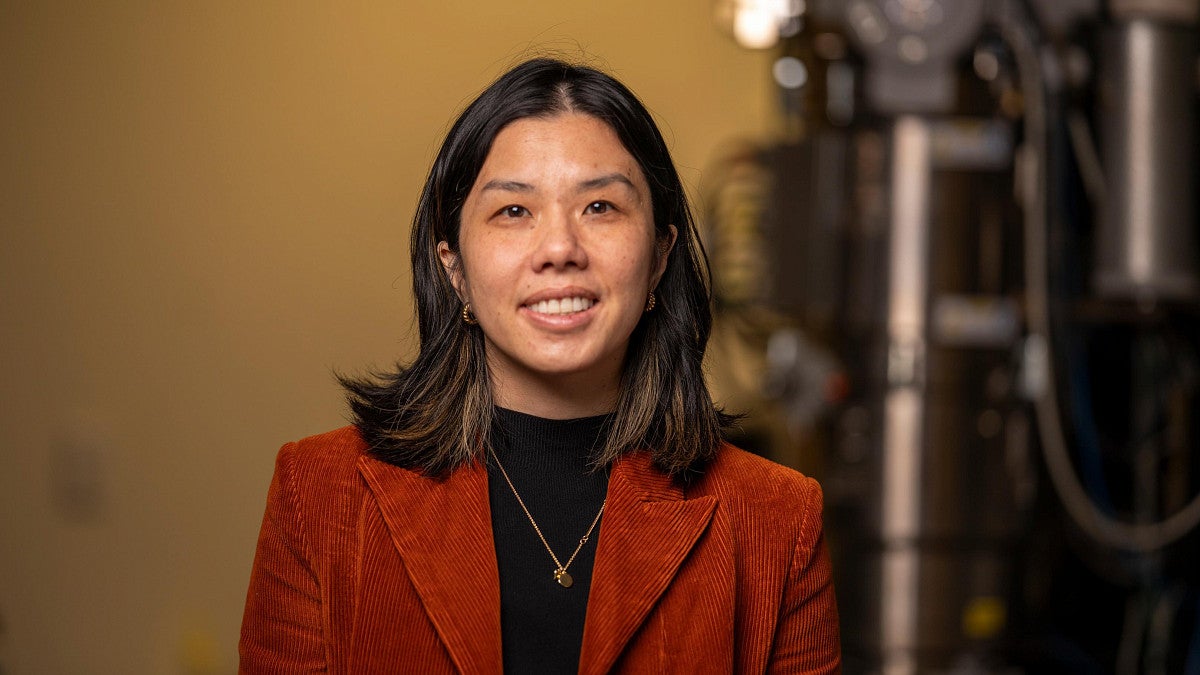
The path to becoming a physicist began when Kayla Nguyen was eight years old. Her mother took her to California State University, Fullerton, to hear physicist and astronaut Sally Ride speak, an experience that sparked a lifelong fascination with physics and a curiosity that has driven a career that has earned Nguyen accolades and recognition.
Now an assistant professor of physics at the University of Oregon College of Arts and Sciences, Nguyen has been named the 2025 recipient of the American Physical Society’s (APS) Maria Goeppert Mayer Award. Named after a German American theoretical physicist who was co-awarded the 1963 Nobel Prize in Physics, this award honors exceptional achievement by a woman physicist in the early years of her career.
—Kayla Nguyen, Assistant Professor, Physics
Early curiosity turned career
Nguyen’s path to discovery began with that childhood dream of becoming an astronaut. “After hearing Sally Ride, I decided I’d study physics because that’s how you become an astronaut,” she laughed. “But once I actually started studying the universe, I realized I cared more about the small things, the atoms and materials that make it up.”
At the University of California, Santa Barbara, Nguyen joined the College of Creative Studies majoring in physics. She then earned her PhD at Cornell University, where she helped develop a new kind of detector that could capture atomic-scale details with unprecedented clarity. “Instead of looking at galaxies,” she said, “I learned to build the instruments that let us see atoms.” The detector she co-developed as a graduate student is now sold by Thermo Fisher Scientific and used at research centers worldwide.
Nguyen’s research focuses on creating the next generation of electron microscope technology, which includes computational tools and new instrumentation that allow scientists to see and measure materials at the scale of individual atoms.
Her work bridges physics, materials science and computer science. “When you design detectors, microscopes or new computational frameworks, you’re really designing new ways to look at the microscopic world,” she said. “Once you have the tool, anyone — biologists, chemists, physicists — can use it to ask their own questions.”
Supporting women in physics
The Maria Goeppert Mayer Award carries special meaning because of the woman it’s named for. “Maria Goeppert Mayer spent much of her career as an unpaid professor because of the gender discrimination faced by women during that time,” Nguyen said. “This award exists because people recognized how unfair that was and wanted to make sure women in physics today are seen and supported.”
The APS cited her “pioneering contributions to electron microscopy, including the co-invention of the electron-microscope pixel array detector, imaging of negative capacitance in topological ferroelectrics, advances in electron ptychography, and efforts to democratize science”.
Still, bias persists in science. “People sometimes assume a woman’s achievements are due to someone else’s help,” she said. “They overvalue potential in men but undervalue it in women. It is important that we recognize the work of women trailblazers and not forget the progress that they made to make science more equitable.”
Serving as a mentor for the next generation of scientists
Nguyen joined CAS in 2023 and has made mentorship a central part of her lab culture. “I believe good research starts with good mentoring. Students here may have jobs or family responsibilities, but that doesn’t mean they lack talent, it means we as faculty have to meet them where they are.”
Nguyen’s message to young scientists, especially women in physics, is direct: “Believe in yourself, and trust no one blindly. If something doesn’t make sense, test it yourself. You’re the scientist — you figure it out.”
She credits that mindset, encouraged by her PhD advisor, David Muller, for fueling her creativity and independence. “Skepticism can be healthy,” she said. “It pushes you to go deeper and find your own answers.”
That skepticism is what drives her curiosity. And that is the mindset Nguyen wishes to impart to her students.
“Keep asking questions and never stop figuring things out,” Nguyen said.
— By Maria Soto Cuesta, College of Arts and Sciences
— In 2025, APS awarded CAS physicists Eric Corwin and Ben McMorran American Physical Society Fellowships. Corwin was recognized for his outstanding contributions to the physics of the glass and jamming transitions using simulations and experiments. McMorran was recognized for his contributions to electron matter wave physics.