
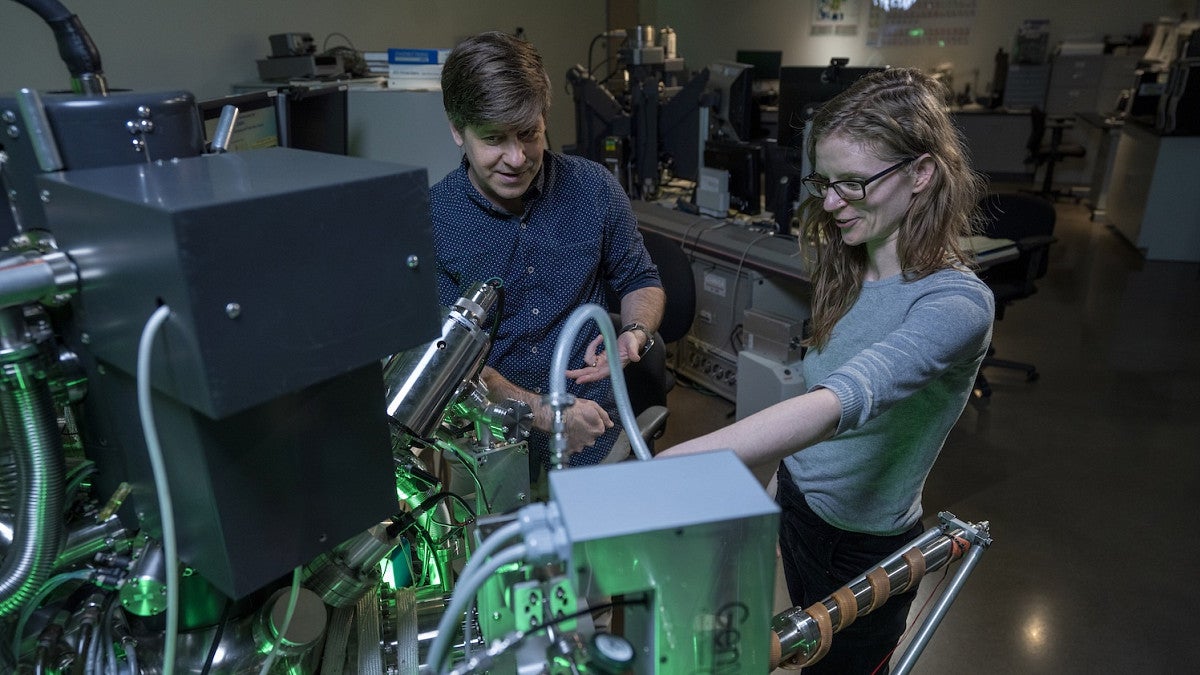
The world is on the cusp of a new technological era enabled by the next generation of synthetic materials — and today’s students have a unique opportunity to help shape it.
A new cutting-edge major in the University of Oregon College of Arts and Sciences prepares students to drive technological change through high-demand careers in fields such as semiconductor manufacturing, energy and sustainable materials development.
“If you think about our society and how we improve, going from the Bronze Age to the Silicon Age, we’re able to develop new tools once we have access to new materials,” said Kayla Nguyen, assistant professor of physics. “The thing is, we’re not stopping at silicon. There is a whole entire periodic table and a large number of combinations we can use to make new materials with different properties. Students who learn how to do this could be at the forefront of a revolution to bring in the next materials age.”
Launched in fall 2025, the Materials Science and Technology Program is the state’s first undergraduate materials science major designed to equip students with the knowledge and skills to research, develop and characterize new materials for use in industrial and technological applications.

“Materials science underlies pretty much every kind of technology we deal with in everyday life,” said Jayson Paulose, associate professor of physics and director of the new major. “At some point, technology has to be built, and a materials scientist has to invent the materials for it.”
The program fills a critical instructional gap in the state’s university system, said Matthias Agne, assistant professor of chemistry and biochemistry and board member for the program.
“A lot of next-generation computing and energy technologies are going to need materials scientists. This program will help fill that knowledge gap and contribute to the workforce needed for those industries,” he said.
“It’s an excellent example of how learning about fundamental research in physics and chemistry can teach students to engage in scientific thinking and give them the tangible skills needed to compete in the job market, while meeting the needs of technology employers in Oregon and across the country,” added Elliot Berkman, divisional associate dean for the natural sciences.
An expanding hub for materials science
The materials science and technology major draws upon the UO’s history as a leader in materials science.
The university houses world-class materials characterization facilities as well as the Materials Science Institute, an interdisciplinary coalition of 35 researchers with a collective $18 million in grant funding who are actively involved in developing and studying new materials and technologies.
“Historically, materials science has been a strength at the University of Oregon,” Paulose said. “The materials science and technology major is strongly grounded in both fundamental science and cutting-edge research. Working at the forefront of technology is an important part of the training we’re providing.”
The interdisciplinary major combines coursework from both the Departments of Physics and Chemistry and Biochemistry and bridges the gap between fundamental and applied science.
“If you want to go straight into industry, this program will set you up for that. If you want to go to one of the top graduate schools in the country, it will set you up for that,” Agne said. “The rigor of our program will prepare students for pretty much anything they want to do next in their career.”
In addition to learning the fundamentals, students can explore more specialized areas within the field through new courses specially developed for the program. For example, they can investigate how solar cells and batteries work, how to analyze the life cycle of a material, how to characterize materials on a nano scale, and how polymers such as plastic are made and recycled.
Materials science majors also will gain experience conducting authentic research through an embedded course on the fundamentals of scientific inquiry while engaging in experiential learning through hands-on projects, industry partnerships and other faculty-led research opportunities.
“If a student has a passion for physics, chemistry and engineering, a materials science degree is a really great option because it combines all three,” Nguyen said. “Materials science is for everybody.”
Advancing technology through materials science
Students in the materials science major will learn from — and conduct research with — world-class CAS faculty who are working on some of the world’s most complex problems, from decarbonization and renewable energy to developing new materials for creating and testing biomedical devices.
“Materials science is a field that’s connected to some of the most pressing problems we face as a society,” said Celeste Melamed, assistant professor of chemistry and biochemistry, whose research focuses on solid-state batteries for use in solar and other forms of renewable energy.
At the opposite end of the spectrum, Teresa Rapp develops biomaterials designed to mimic the interior of the human body for use in biomedical research and applications such as growing new cells in a lab.
“We make very soft and squishy water-filled materials that are supposed to look like your body, which is 95% water,” said the associate professor of chemistry and biochemistry. “We want to explore how to make synthetic materials for laboratories that really match the tissue materials in your lungs, brain and stomach.”
Understanding the life cycle of synthetic materials is another critical aspect of materials science that will play a key role in making technology and industry sustainable.
“A key part of the field of materials science, especially now and moving into the next few decades, is looking at the life cycle of materials,” Melamed said. “It’s not just about whether we can make it into something good, but also where we source it from and how. Is it humane or will it do harm? How are we manufacturing it? Life cycle analysis is a new and upcoming field within the materials science community to help green the work we do.”
Because the need for materials scientists is so high, the new major provides students with an entry point into a field with nearly unlimited potential for making an impact.
“As a society, there’s so much knowledge out there we don’t know yet,” Nguyen added. “If we get people working on these problems, the world could benefit a lot.”
—By College of Arts and Sciences Communications