
When the human body is in space, it experiences “anti-exercise.”
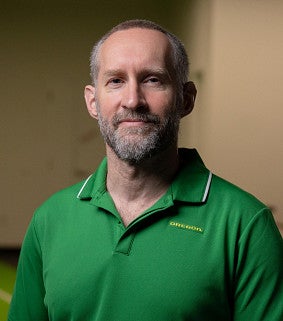
“If exercise builds muscle and bone and improves heart function, then being in microgravity does the opposite,” said John Halliwill, a College of Arts and Sciences (CAS) human physiology professor, whose research looks at the human cardiovascular system in extreme conditions, such as in space. “Astronauts need to do a lot of exercise on longer-duration missions to offset the losses associated with spaceflight.”
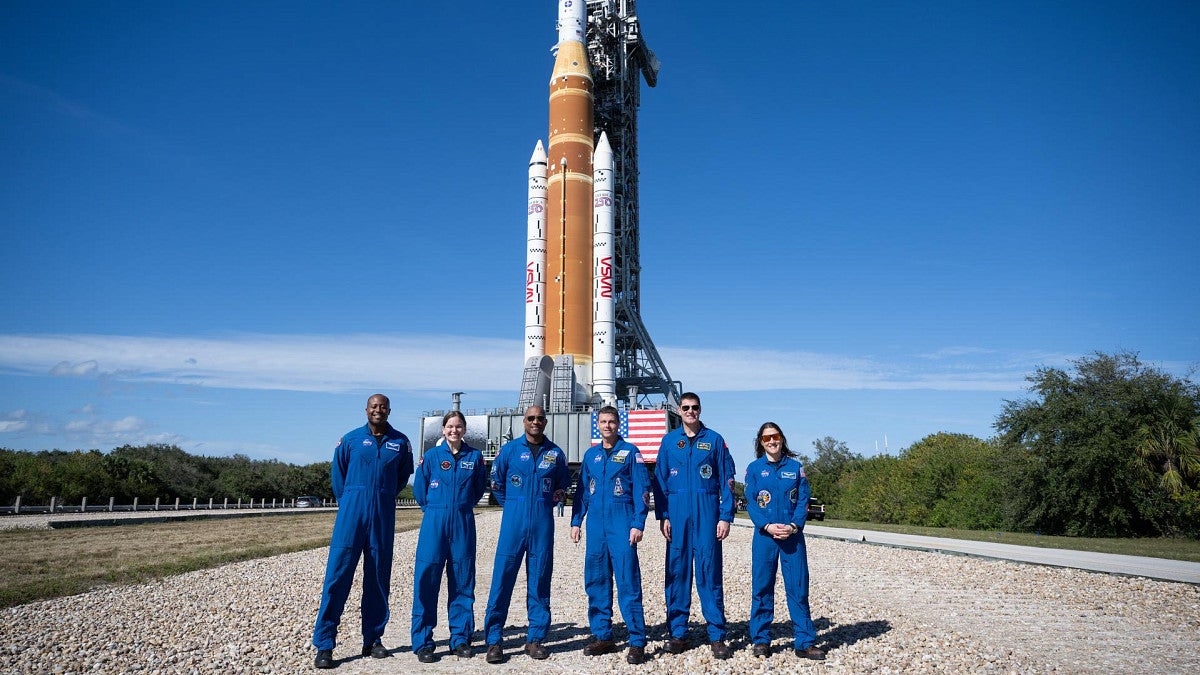
NASA is planning to send humans on a lunar flight for the first time since the Apollo 17 mission in 1972. According to NASA, the 10-day mission via Artemis II in 2026 will test spacecraft technologies with deep space capabilities of humans. It could be an early step toward humans going to Mars.
As humans plan to return to the moon for the first time in more than 50 years, Halliwill spoke with CAS Connection about the wonders of space flight and what the human body endures and adapts to in the weightless realm of space — as well as when returning to Earth.
CAS Communications: How does the body adapt to space travel, and how do astronauts prepare for it?
John Halliwill: We’ve engineered spacecraft to protect us from the inhospitable aspects of space, so the primary conditions astronauts face are the ways the body adapts to the loss of our normal gravitational load.
For example, the little parts of our inner ear that respond to gravity and help us stay oriented and knowing which way is up, they float freely in microgravity. This creates some sensory conflict and often results in a bit of motion sickness, known as Space Adaptation Syndrome, early in the flight. After a few days, the brain learns how to ignore the inputs that don’t add up, and the symptoms get better. Some of the current crew’s training is likely to involve countermeasures for Space Adaptation Syndrome and extensive flight training to build more adaptable spatial awareness.
Early on a mission to space, the body fluids shift toward the head, causing a feeling of congestion or puffiness in the face. Artemis II will be a 10-day mission, much like the Space Shuttle program flights from 1981 to 2011. We know from those flights that some of the astronauts will come back a bit low on fluids – when body fluids shift toward the head, the body reacts as if we have too much fluid, and over the mission, the body dumps some of that fluid – we pee it out. They need to reverse that pattern for landing day – get fluid back in, so that they don’t get light-headed when they come back to our normal gravitational load.
CASCOMMS: As someone whose expertise is focused on the human body in extreme conditions and an interest in space flight, what are you looking forward to about Artemis II?
JH: The crew of four will be the first humans to go beyond Low Earth Orbit in over 50 years. Do you know only 27 humans have done that, ever? I’m looking forward to seeing what it is like aboard the Orion spacecraft (the latest model); it's much bigger than what was used for the Apollo missions. Orion has enough space for a custom exercise machine called ROCKY (Resistive Overload Combined with Kinetic Yo-yo. You have to have at least one acronym in a spaceflight interview).
Ideally, the astronauts will perform rowing, squats, deadlifts and curls throughout the mission to help them maintain fitness. I’m also interested in seeing what they learn about radiation exposure. The Earth generates a protective shield against much of the background cosmic radiation, but the farther we go, the more of a concern radiation becomes. They have a few experiments on Artemis II that will track the crew’s radiation exposure – the capsule has much better shielding than the Apollo capsule had.
But let’s talk about what is most exciting: The Orion capsule sits on top of the Space Launch System. It’s massive. It uses two solid rocket boosters, like the Space Shuttle, plus four liquid-fuel engines. It is the most powerful rocket ever built. I’ve seen the uncrewed Artemis I launch video, and it's breathtaking. I love talking about the physiology and science, but when this thing launches, I’m a little kid just staring in awe.
CASCOMMS: How does the Department of Human Physiology prepare students for careers in aerospace?
JH: In human physiology, we think about how stress leads to adaptation. If you challenge the body with a new stressor, like exercise, it will adapt over time. If you cause an injury, the body responds with well-defined mechanisms. It’s all about cause and effect. What students learn in our courses is the underpinnings of these patterns, why they happen the way they do. They learn to identify the cause-and-effect of human physiology, which is a powerful tool for problem-solving in medicine and extends to what happens in spaceflight. In general, an education in human physiology hones critical thinking about the systems that support health, wellness and human performance.
More specifically, I teach a class that focuses on spaceflight physiology. In HPHY 410: Mission to Mars, students collaborate as physiologists to tackle challenges related to human missions to Low Earth Orbit, the Moon and Mars. I point to our alumni who work as aerospace physiologists as examples. They are vital for ensuring the health and safety of astronauts and pilots. They do experiments that contribute to our understanding of human adaptation to space environments and play a crucial role in ensuring flight and mission success.
— By Henry Houston, CAS Communications
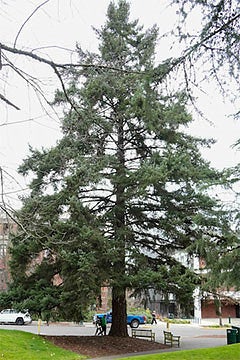
Houston, We Have a Moon Tree on Campus
The last time NASA sent a crew to the Moon, one astronaut brought along with him seeds for what are now called “Moon trees.” These Moon trees are scattered all around the country and the University of Oregon campus is home to a Douglas fir planted in 1976, 100 years after the founding of the University of Oregon campus. In 1987, the tree was transplanted for the construction of Willamette Hall to where it stands now between the Erb Memorial Union and Carson Hall.
“The size of the tree reminds me how long we have been away from the Moon. That we went there, and this tree, just a seed at the time, went along for the ride. And it came back, and someone planted it, and it flourished,” Professor John Halliwill said. “Life can adapt. We can adapt. As a people, we traveled a quarter million miles to the Moon and back safely. This tree grows as a reminder of that experience, and when we go back around the Moon on the Artemis II mission, it will be a silent witness to that trip.