News

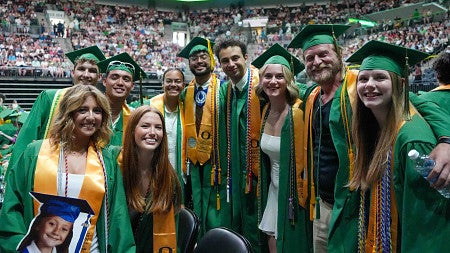
Highlights from the June 15 University of Oregon College of Arts and Sciences commencement ceremonies at Autzen Stadium and Matthew Knight Arena.
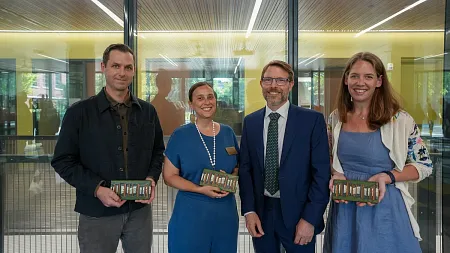
BIOLOGY - The annual Tykeson Teaching Awards were granted to faculty in archaeology, biology and cinema studies. Laurel Pfeifer-Meister was honored for her work with students in a three-course series. Pfeifer-Meister is an associate teaching professor in the Department of Biology and the lead instructor for the Honors/Accelerated Biology 281, 282 and 283 laboratory sequence.
BIOLOGY, HISTORY - Associate Professor Melissa Graboyes and the students in her Global Health Research Group study historical materials to better understand malaria and strategies to address it. So far, they've found that there is no simple “silver bullet” for malaria. Instead, the realistic approach is one that is multi-pronged with the goal of malaria control — keeping malaria rates low. Alumni of this group — both biology majors — have cited the interdisciplinary experience as instrumental to their post-UO successes.
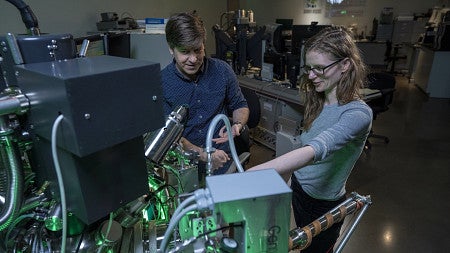
PHYSICS, CHEMISTRY, BIOCHEMISTRY, BIOLOGY — A new cutting-edge major in the University of Oregon College of Arts and Sciences prepares students to drive technological change through high-demand careers in fields such as semiconductor manufacturing, energy and sustainable materials development.
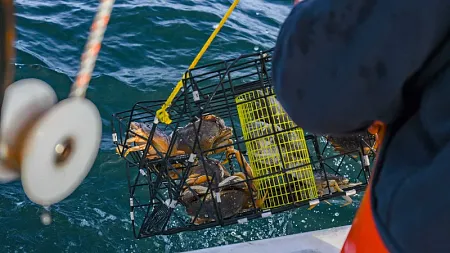
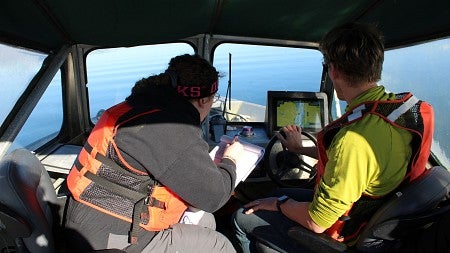
BIOLOGY - Marine biologist Alan Shanks has a simple trap that allows him to predict the amount of Dungeness crab will be available for fisherfolk. For the past 25 years, Shanks has compared the yields of the winter commercial catch to the baby crabs his water-jug trap collects each summer. He’s found that the number of baby crabs that arrive on the coast can be used to estimate the size of the state’s commercial harvest of adult Dungeness crab years in the future, with a 12 percent margin of error.
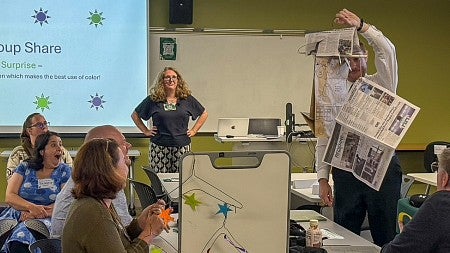
During the summer, 25 faculty members from the college’s Division of Natural Sciences took part in the Mobile Summer Institute for Scientific Teaching. The weeklong workshop offered faculty members ways to transform traditional lectures to be more inclusive and hands on that puts students at the center of learning. It brought together instructors not only from disciplines such as biology, chemistry, and physics—and across the campus.
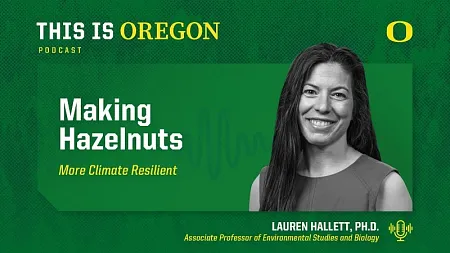
BIOLOGY - Lauren Hallett, biology associate professor at the College of Arts and Sciences discusses her ongoing work to enhance the climate resiliency of Oregon’s hazelnut farms, which account for 99% of the country's hazelnut production. With the support of a $2 million federal award, Hallett and her lab have designed an agricultural practice using native cover crops and basalt dust amendments to set a new standard for sustainable hazelnut farming.
BIOLOGY - An expert on child and adolescent development and an expert on host-microbe interactions have each been recognized by the Medical Research Foundation of Oregon of the Oregon Health and Science University. Karen Guillemin, professor and Philip H. Knight Chair in biology in the College of Arts and Sciences, received the Discovery Award for her significant contributions to health-related research.
BIOLOGY - New in 2025, the Coastal Quarter program allows undergraduates from all majors to spend winter term living at the coast and taking classes in marine biology, environmental studies, anthropology and science communication. Out of the nine students who participated this year, five are majoring in either environmental sciences or environmental studies; four are marine biology majors; and one is a sports journalism major.
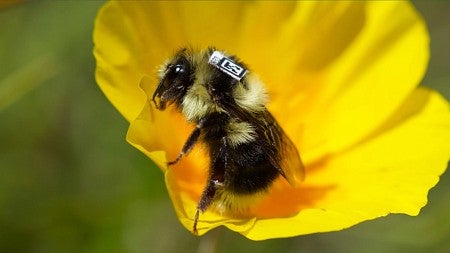
BIOLOGY - An AI-based imaging system that is a collaboration between researchers at the University of Oregon and Oregon State University, funded by the National Council for Air and Stream Improvement Inc., is working to monitor bee populations without harming the insects. The technology could solve a key paradox in bee conservation efforts. The collaboration includes CAS biologist Lauren Ponisio.
BIOLOGY - Franklin W. Stahl, a molecular biologist who helped create a methodology to confirm how DNA replicates that was so elegant, it has been remembered for more than five decades as “the most beautiful experiment in biology,” died on April 2 at his home in Eugene. He was a professor in the College of Arts and Sciences.
BIOLOGY, CHEMISTRY AND BIOCHEMISTRY - The University of Oregon is now home to three new senior members of the National Academy of Inventors, a designation that recognizes visionaries and innovators whose technologies brought, or aspire to bring, a real impact on society. The CAS faculty members are Karen Guillemin, Mike Pluth and Ramesh Jasti.
HUMAN PHYSIOLOGY, PSYCHOLOGY - Our health is affected by factors that take root in early childhood and follow us our entire lives. Explore CAS research on a range of health issues, from how sleep affects infant development to what causes age-related memory disorders such as Alzheimer's disease. Read more in the Annual Research Report, out now!
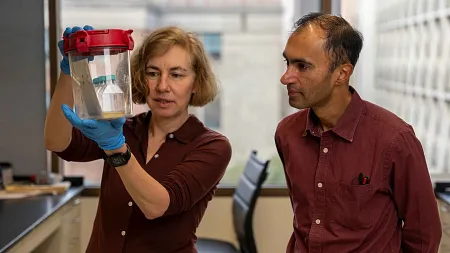
BIOLOGY, PHYSICS - A new study published in the journal mBio shows how one kind of bacteria, Vibrio cholerae, triggers those painful contractions by activating the immune system. The research also finds a more general explanation for how the gut rids itself of unwanted intruders, which could also help scientists better understand chronic conditions like inflammatory bowel disease. The research was led by Julia Ngo, a now-graduated doctoral student in Karen Guillemin and Raghu Parthasarathy’s labs.
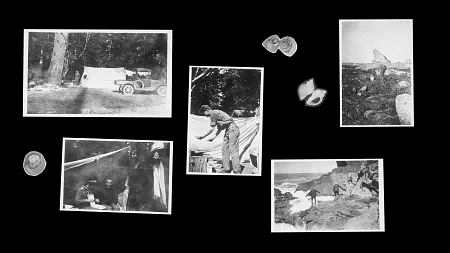
BIOLOGY - In 1924, the University of Oregon began teaching marine biology classes in a ramshackle collection of tents in a cove along the southern Oregon Coast. But what started as a couple of professors bringing some students on a summer camp has now become a permanent, year-round marine field station with a hundred years of coastal research and education.