
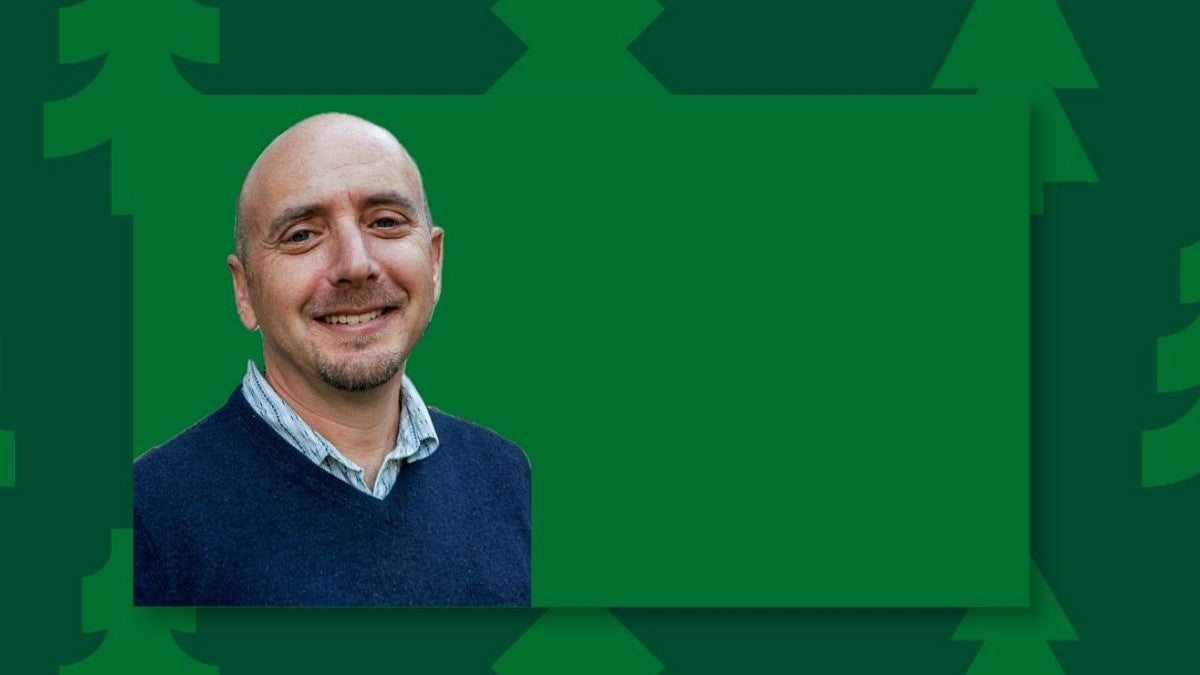
The University of Oregon Department of Mathematics will host distinguished mathematician Victor Reiner for a three-day lecture series early next month, exploring the intersections of algebra, geometry, and advanced counting techniques. Reiner, a Distinguished McKnight Professor in Mathematics at the University of Minnesota, is a prominent figure in the field of combinatorics—the study of finite or countable discrete structures.
A Princeton University alumnus, Reiner earned his PhD from the Massachusetts Institute of Technology (MIT) under the guidance of renowned mathematician Richard Stanley. His career accolades include an NSF Postdoctoral Fellowship, a Sloan Fellowship, and election as a Fellow of the American Mathematical Society, where he has also served on the AMS Council.
Beyond his research and his mentorship of 22 PhD students, Reiner is the treasurer of the Combinatorics Consortium, which promotes conferences and sponsors several "diamond open access" journals in combinatorics. The diamond open access publishing model makes research freely accessible to authors and readers alike.
His upcoming visit to the UO campus will feature three distinct talks, beginning with an accessible presentation for general audiences followed by two specialized research seminars. All lectures are free and open to the university community and interested members of the public.
Lecture Schedule and Topics
Talk 1: Algebra and q-counting (General Audience)
Tuesday, June 2, 4-5 p.m.
128 Chiles Hall
Abstract : Enumerative combinatorics tries to count things, but also often “q-counts” them, adding a parameter q that tracks some meaningful statistic on the objects. This talk will illustrate how q-counting can help with ordinary counting, using just a tiny amount of algebra. The family of objects that we q-count will include as special cases subsets, number partitions, necklaces with black/white beads, and unlabeled graphs.
Talk #2: Reflection Groups and q-counting
Wednesday, June 3, 4-5 p.m.
125 McKenzie Hall
Abstract : Three classic combinatorial counts are given by binomial coefficients, the numbers n^{n-2}, and the Catalan numbers. We make the case for a particular choice of q-count in each case, arguing from two viewpoints. The first is that these q-counts hide information about counting under cyclic symmetry. The second is that these q-counts all generalize to finite real reflection groups. The two viewpoints are related by a ring deformation proof technique, proven for two of the three counts, conjectural for the last.
Talk #3: Ehrhart Theory and q-counting
Thursday, June 4, 1:30-2:30 p.m.
245 Straub Hall
Abstract : Classical Ehrhart theory begins with this fact: for a convex polytope P whose vertices lie in the integer lattice Z^n, the number of lattice points in the positive integer dilates mP grows as a polynomial function of m. We will review highlights of the classical theory, and explain a new version (joint with Brendon Rhoades, arXiv:2407.06511) that q-counts the points in the dilation. There are q-analogues for many classical Ehrhart theory results, some proven, others conjectural. Deformation of rings and commutative algebras play a prominent role.